


Impact-Resistant Laminated Glass is engineered for applications that require enhanced protection against impact, penetration, and glass fragmentation. It is usually manufactured by combining two or more glass layers with a high-performance interlayer, such as PVB, SGP, PU, or a polycarbonate (PC) layer. In specialized constructions, glass and PC polycarbonate can be bonded under high pressure to create a composite glazing system with strong adhesion and enhanced impact resistance.
Impact-Resistant Laminated Glass is a multi-layer glazing system in which glass sheets are bonded together by an interlayer. Depending on the required protection level, the interlayer may be made from PVB, SGP, PU, PC polycarbonate, or a combination of glass and polymer materials.
Unlike ordinary monolithic glass, its performance is determined by the combined design of the glass, interlayer, PC layer, dimensions, edge support, and installation system.
Common constructions include:
Glass + Interlayer + Glass
For higher protection requirements, additional layers may be added:
Glass + Interlayer + Glass + Interlayer + Glass
Specialized impact-resistant systems may also use a glass and PC polycarbonate structure:
Glass + PU Film + PC Polycarbonate
or:
Glass + Interlayer + Glass + PU Film + PC Polycarbonate
In these constructions, the glass provides surface hardness and optical clarity, while the PU film and PC polycarbonate layer contribute strong adhesion, energy absorption, impact resistance, and penetration resistance. The final configuration should be selected according to the required impact or security classification and validated against the applicable project standard or test requirement.
· Helps retain glass fragments after breakage
· Improves resistance to impact and penetration
· Supports glass, PU film, and PC polycarbonate composite structures
· Provides strong adhesion between glass and polymer layers
· Helps maintain a protective barrier after damage
· Available with clear, ultra-clear, or tinted glass
· Supports PVB, SGP, PU, PC polycarbonate, and other specified materials
· Can be produced in customized dimensions and shapes
· Suitable for drilling, edge processing, and other fabrication
· Available in multi-layer constructions for enhanced protection requirements
· Can provide a balance of optical clarity, durability, and impact resistance
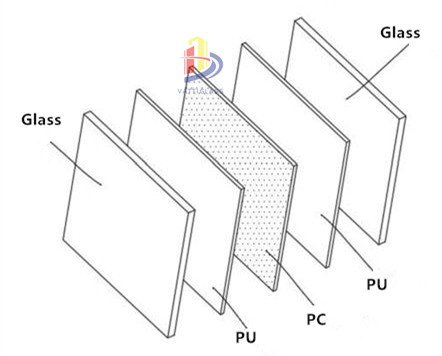
Impact-resistant laminated glass with PC polycarbonate offers a more advanced protective structure than conventional glass-only laminated glazing. When an impact occurs, the glass may crack or break, while the PU film and PC polycarbonate layer help hold the structure together and absorb impact energy.
The interlayer remains bonded to the glass fragments after breakage, helping reduce hazardous shard dispersal and maintaining the integrity of the glazing assembly.
PU film can provide strong bonding between glass and PC polycarbonate. Under controlled high-pressure lamination, the materials form a stable composite structure that helps prevent separation between the layers.
PC polycarbonate has high toughness and impact resistance. When combined with glass and PU film, it can improve the glazing system’s ability to withstand repeated or severe impacts.
The combination of glass, PU film, and PC polycarbonate creates a multi-layer barrier. Even if the outer glass layer is damaged, the polymer layer can help resist penetration and maintain the protective function of the glazing.
Different combinations of glass thickness, glass type, PU film thickness, PC thickness, interlayer type, and layer count can be engineered for different project requirements.

Impact-resistant laminated glass with PC polycarbonate is suitable for locations where ordinary glazing may not provide sufficient protection against accidental or deliberate impact. The glass and polycarbonate combination can provide enhanced resistance to impact and penetration while helping maintain a protective barrier after damage.
In villas and high-end residences, glass with PC polycarbonate can be used for entrance doors, security doors, large windows, and other exposed glazing areas. It provides a transparent protective layer without significantly changing the architectural appearance, making it suitable for projects that require both security and design quality.
Banks may use this glazing for security partitions, teller areas, customer service counters, and entrance systems. The laminated glass and PC structure helps create a stronger separation between staff and visitors while maintaining visibility and communication.
Museums and cultural buildings can use impact-resistant glass with PC polycarbonate for high-value exhibit cases and protective viewing panels. The transparent construction allows visitors to view exhibits clearly while adding protection against accidental impact and attempted penetration.
Jewelry stores and luxury retailers may install this glazing in display cases, storefronts, and security showcases. It helps protect valuable products while preserving clear visibility and a refined appearance, making it suitable for both interior displays and street-facing shopfronts.
The appropriate glass and PC polycarbonate configuration should always be determined according to the security objective, panel size, framing system, and relevant building or testing requirements.

Selecting impact-resistant laminated glass with PC polycarbonate requires more than choosing a thicker panel. The glazing should be evaluated as part of the complete installation system.
1. Required Impact Level
Determine whether the project requires resistance to accidental human impact, deliberate impact, repeated impact, penetration, or a defined security classification.
2. Applicable Standards
Identify the required local, national, or project-specific testing standard before finalizing the glass, PU film, and PC polycarbonate construction.
3. Glass Dimensions
Panel size and aspect ratio affect structural behavior and should be considered during specification.
4. Support & Framing
The frame, fixing system, edge support, and installation method must be compatible with the selected glass and PC polycarbonate configuration.
5. Interlayer Selection
PVB, SGP, PU film, PC polycarbonate, and other interlayers should be selected according to required performance, environment, and processing conditions.
6. PC Polycarbonate Compatibility
The PC grade, surface treatment, thickness, optical requirements, and bonding compatibility should be confirmed before production.
7. Environmental Conditions
Temperature, humidity, UV exposure, chemical exposure, and installation environment should be considered when selecting the PU film, PC polycarbonate, and overall construction.
8. Lamination Process
The glass, PU film, and PC polycarbonate should be laminated under controlled high-pressure conditions to achieve strong adhesion and reliable long-term performance.
9. Post-Breakage Performance
For security-oriented projects, specify the required behavior after impact, including fragment retention, resistance to penetration, and the ability of the PC layer to maintain the barrier.

VATTI uses precision glass processing and high-pressure lamination equipment to produce customized impact-resistant laminated glass with PU film and PC polycarbonate.
Glass type, thickness, size, and optical requirements are confirmed according to the project specification.
The PC grade, thickness, surface condition, optical requirements, and compatibility with the PU film are confirmed according to the required impact performance.
Glass and PC polycarbonate sheets are cut to the required dimensions using precision cutting equipment.
Glass edges can be polished, arrissed, beveled, or processed according to the installation and fabrication requirements. PC edges can also be prepared according to the bonding and framing design.
Holes, cut-outs, irregular shapes, and other precision features can be processed before lamination when required by the design.
Glass and PC surfaces are carefully cleaned and prepared to ensure reliable bonding between the glass, PU film, and PC polycarbonate.
The glass, PU film, PC polycarbonate, and any additional interlayers are assembled according to the approved layer structure.
The assembled package undergoes controlled preliminary bonding to remove air and prepare the structure for final high-pressure lamination.
The assembly is processed under controlled temperature and high-pressure conditions. This process helps synthesize the glass, PU film, and PC polycarbonate into a composite structure with strong adhesion and enhanced impact resistance.
Finished panels are inspected for dimensions, appearance, edge quality, optical defects, bonding quality, bubbles, delamination, and overall lamination performance before packaging.

Impact-resistant glazing projects often require more than standard glass sizes. VATTI provides customized processing and production support based on project drawings, specifications, and application requirements.
· Custom dimensions
· Custom glass thickness
· Custom PC polycarbonate thickness
· Irregular shapes
· Drilled holes
· Cut-outs
· Edge processing
· Surface effects
· Customized glass colors
· PVB, SGP, or PU film selection
· Glass and PC polycarbonate composite structures
· Multi-layer laminated constructions
Customers can provide drawings, dimensions, glass specifications, PC requirements, required standards, quantities, and application information. VATTI can then assist with confirming a suitable production configuration.
For large projects, sample development and production batches can be coordinated according to the agreed technical requirements. Sample testing can also be arranged when the project requires verification of impact resistance, penetration resistance, adhesion, or post-breakage performance.
VATTI has more than 16 years of experience in glass manufacturing and international export, with products supplied to customers in more than 80 countries.
Our production capabilities include precision cutting, edging, tempering, autoclave lamination, high-pressure lamination, water jet cutting, CNC processing, and hole processing.
We support custom dimensions, shapes, drilling, edge processing, surface effects, glass types, PC polycarbonate thicknesses, and project-specific laminated structures.
Glass dimensions, processing accuracy, appearance, PC surface condition, bonding quality, and finished laminated quality are inspected throughout production. Product tolerances can be manufactured according to applicable American, European, or project-specific requirements.
Our location near Qingdao’s major container ports supports efficient container loading and international shipment arrangements.
Our sales and technical teams provide project communication, specification confirmation, production coordination, and after-sales support, with online responses targeted within 24 hours.
No. The glass surface can still crack or break under sufficiently high impact. Its key safety advantage is that the PU film and PC polycarbonate layer help retain the broken glass, absorb impact energy, and maintain a protective barrier after damage. The actual impact and penetration performance depends on the complete tested configuration.
Tempered glass is strengthened through thermal treatment and has high mechanical and thermal resistance. When it breaks, however, it generally fragments into many smaller pieces. Laminated glass uses an interlayer to bond multiple glass layers together and retain fragments after breakage. When PC polycarbonate is added, the glazing can also provide enhanced impact resistance and post-breakage barrier performance.
PC polycarbonate is used because it has high toughness, strong impact resistance, and good resistance to penetration. When bonded to glass with PU film under controlled high pressure, it can create a composite glazing structure with strong adhesion and enhanced protective performance.
PU film bonds the glass and PC polycarbonate together. It provides strong adhesion and helps transfer and absorb impact energy within the composite structure. Proper lamination conditions are important to achieve reliable bonding and reduce the risk of delamination.
There is no single interlayer that is best for every project. PVB is widely used for safety glazing, while SGP can provide higher stiffness and structural performance. PU film is suitable for specialized glass and PC polycarbonate constructions requiring strong adhesion and impact-energy absorption. The appropriate material depends on the required performance and testing standard.
Large panels can be manufactured depending on the available glass and PC sheet sizes, processing equipment, lamination capability, transportation conditions, and project requirements. The maximum practical size should be confirmed before production.