


Ceramic Stove Glass serves as the functional and visual centerpiece of modern cooktops, providing a durable cooking surface capable of withstanding demanding thermal conditions. Its stable performance under repeated heating cycles, together with flexible customization options, makes it an ideal choice for appliance manufacturers seeking both performance and design versatility.
Ceramic Stove Glass is a high-performance glass-ceramic material engineered for use in induction cooktops, electric hobs, and other high-temperature cooking appliances. It combines excellent thermal stability, mechanical strength, and a refined surface appearance, making it a reliable material for modern cooktop systems.
Manufactured through a controlled crystallization process, ceramic stove glass features an extremely low coefficient of thermal expansion, allowing it to maintain dimensional stability under rapid temperature changes. Its outstanding thermal shock resistance supports long-term structural integrity during repeated heating and cooling cycles.
The smooth, non-porous surface provides strong resistance to stains, grease, and everyday wear, while also supporting easy cleaning and maintenance. Its sleek finish and compatibility with contemporary appliance designs further enhance its value in premium product development.
As demand continues to grow for safer, more durable, and energy-efficient cooking technologies, ceramic stove glass remains a preferred material choice for manufacturers seeking dependable performance and a modern visual finish.
Ceramic Stove Glass refers to a specially engineered cooktop surface developed through a controlled crystallization process applied to high-purity raw materials. During production, selected regions of the glass matrix are transformed into microscopic crystalline phases, creating a hybrid structure that differs fundamentally from conventional fully amorphous glass.
The manufacturing process begins with the melting of carefully selected raw materials to form a uniform glass substrate. This substrate then undergoes a precisely regulated heat-treatment cycle, during which crystal nuclei form and grow throughout the body of the material. The resulting microcrystalline structure gives the panel its characteristic dimensional stability at elevated temperatures and its strong resistance to thermal stress.
With this engineered internal structure, ceramic stove glass occupies a position between traditional glass and advanced technical ceramics. It retains the smooth surface quality, processing flexibility, and visual clarity associated with glass, while delivering the thermal stability and durability expected from high-performance ceramic-based materials. These characteristics make it well suited for modern cooking appliances that must perform reliably under demanding thermal conditions.
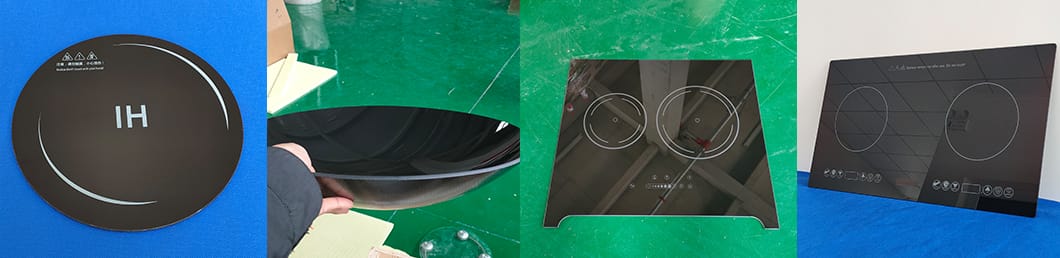
Ceramic stove glass features an exceptionally low coefficient of thermal expansion, allowing it to maintain dimensional stability even when exposed to significant temperature fluctuations. Unlike conventional glass materials that may expand, deform, or crack under thermal stress, glass-ceramic panels remain stable during repeated heating and cooling cycles, ensuring long-term reliability in cooking applications.
Designed for high-temperature environments, ceramic stove glass can withstand continuous operating temperatures of up to 750°C and short-term exposure to even higher temperatures. Its thermal stability enables safe and consistent performance in induction cooktops, radiant cookers, and other heating appliances where prolonged heat exposure is common.
With thermal shock resistance of up to 180K, the material can tolerate rapid temperature changes without structural damage. Whether subjected to sudden heating or cooling, the glass maintains its integrity, reducing the risk of cracking and extending the service life of the appliance.
The engineered microcrystalline structure provides excellent mechanical strength and surface hardness. This helps the panel resist scratches, impacts, and everyday wear caused by cookware movement and frequent use, maintaining both performance and appearance over time.
The non-porous surface prevents grease, liquids, and food residues from penetrating the material. Daily cleaning can typically be performed with a soft cloth and standard household cleaners, helping users maintain a clean and attractive cooking surface with minimal effort.
Ceramic stove glass demonstrates strong resistance to common kitchen contaminants, including oils, sauces, cleaning agents, and food acids. Its stable surface chemistry helps preserve appearance and functionality even after prolonged exposure to demanding cooking environments.
The material is specifically developed for cooking applications where safety is critical. Its ability to withstand high temperatures and thermal stress reduces the likelihood of breakage during operation, providing a safer cooking environment for both residential and commercial users.
Ceramic stove glass is engineered to maintain consistent performance during prolonged exposure to elevated temperatures. Under normal operating conditions, it retains its structural stability, thermal properties, and visual appearance, supporting the long service life expected from modern cooking appliances.
Available in black, white, transparent, and customized finishes, ceramic stove glass offers a premium appearance that complements contemporary appliance designs. Its smooth surface and decorative printing options allow manufacturers to combine functionality with attractive product aesthetics.
Thickness | 4mm,6mm | Heat resistant temperature | 660≤850℃ |
Silica content | >80% | Density(20℃) | 2.23cm-1 |
Stain point | 520℃ | Thermal capacity:(20-100℃) | 0.82KJ*(kg*k)-1 |
Annealing temperature | 560℃ | Thermal conductivity | 1.2W*(M*K)-1 |
Soften point | 820℃ | Thermal shock resistance | 180K |
Refractive index | 1.47 | Max.working temperature | 750℃(long time) |
Color | Black, White, Transparent | Refractive index | 1.47384 |
Processed point(104dpas) | 1220℃ | Thermal expansion coefficient(0-300℃) | 3.3±0.1*10-6K-1 |
Ceramic stove glass is widely used in:
Induction cooktops
Electric ceramic cookers
Built-in kitchen hobs
Commercial cooking equipment
Restaurant kitchen systems
High-temperature heating panels
Household cooking appliances
Its excellent thermal stability and safety performance make it especially suitable for high-frequency cooking environments such as restaurants and catering kitchens.

The production of ceramic stove glass involves a precisely controlled manufacturing process designed to achieve exceptional thermal and mechanical performance.
Carefully selected raw materials are melted at high temperatures to form a homogeneous glass melt, which is then rapidly cooled to produce a uniform glass substrate.
The glass substrate is formed into the required dimensions and geometry through precision shaping processes, ensuring consistent thickness, flatness, and dimensional accuracy.
The formed glass undergoes a controlled two-stage ceramization process, during which microscopic crystalline phases are developed within the glass matrix, creating the characteristic glass-ceramic structure.
Following ceramization, the material is processed according to application requirements, including cutting, edge finishing, drilling, CNC machining, and screen printing.
Depending on functional or aesthetic requirements, specialized surface coatings may be applied to enhance durability, surface protection, or decorative performance.
Quality consistency and product reliability are essential for cooktop glass applications. Each ceramic stove glass panel is inspected and tested during production to help ensure it meets quality requirements and customer specifications.
Thermal Shock Resistance Testing
Temperature Differential Resistance Testing
Impact Resistance Testing
Flatness and Dimensional Inspection
Surface Defect Inspection
Screen Printing Adhesion and Durability Testing
The product complies with internationally recognized quality and environmental standards, including:
CE Certification
RoHS Compliance
These testing procedures and certifications help ensure consistent performance, product safety, and suitability for global markets.
To support diverse appliance designs and manufacturing requirements, ceramic stove glass can be customized across a wide range of specifications. Available options include tailored thicknesses, custom dimensions, complex geometries, and multiple color selections. Decorative and functional processing such as screen printing, CNC machining, hole drilling, edge treatment, and specialized surface coatings can also be incorporated based on application needs.
In addition, customized packaging and labeling solutions are available to facilitate international transportation, inventory management, and OEM branding requirements.
Proper installation and routine maintenance help maximize the performance, safety, and service life of ceramic stove glass. During installation, the panel should be mounted on a flat, stable supporting structure to ensure even load distribution and minimize unnecessary stress. Adequate thermal clearance should also be incorporated into the appliance design to accommodate operating temperatures and maintain long-term reliability.
For daily maintenance, the surface should be cleaned using a soft cloth and non-abrasive cleaning agents to preserve its appearance and functionality. Although ceramic stove glass offers excellent thermal and mechanical stability, direct impact from heavy or sharp objects should be avoided. Regular cleaning and proper handling will help maintain surface quality, decorative printing, and overall product performance throughout its service life.
No. If a ceramic stove glass panel develops visible cracks, it should be replaced as soon as possible. Although minor cracks may not immediately affect operation, continued use can allow the damage to spread under thermal stress, potentially compromising safety and structural integrity.
Minor surface marks may be reduced using specialized glass-ceramic cleaning products, but deep scratches generally cannot be fully repaired. To maintain the appearance and performance of the cooktop, it is recommended to avoid dragging cookware across the surface and to use cookware with smooth, clean bases.
Stubborn burnt-on stains and carbonized residue can typically be removed using a cooktop scraper designed for glass-ceramic surfaces, followed by a non-abrasive cooktop cleaner. For best results, cleaning should be performed regularly to prevent residue buildup. Harsh abrasive materials should be avoided as they may damage the surface finish.
Yes. Cast iron cookware can generally be used on both ceramic and induction cooktops, provided the cookware base is flat and in good condition. However, rough or damaged cast iron surfaces may scratch the glass panel if dragged across the cooktop. Lifting cookware instead of sliding it is recommended.
Yes. In addition to ceramic stove glass, we also supply a range of high-performance glass products, including induction stove glass, fireplace ceramic glass, and other customized glass solutions for household appliances and industrial applications. If you are looking for glass panels for cooktops, fireplaces, ovens, heating equipment, or related projects, please contact us to discuss your specific requirements.
